Private Label Cat Scratcher Packaging: What Buyers Should Specify
For private-label cat scratchers, packaging is more than a container. It protects the product during transport, presents the brand on the shelf, supports e-commerce delivery, and influences the customer’s first impression. Buyers should therefore define packaging requirements clearly before requesting quotations, samples, or mass production.
Start With the Sales Channel
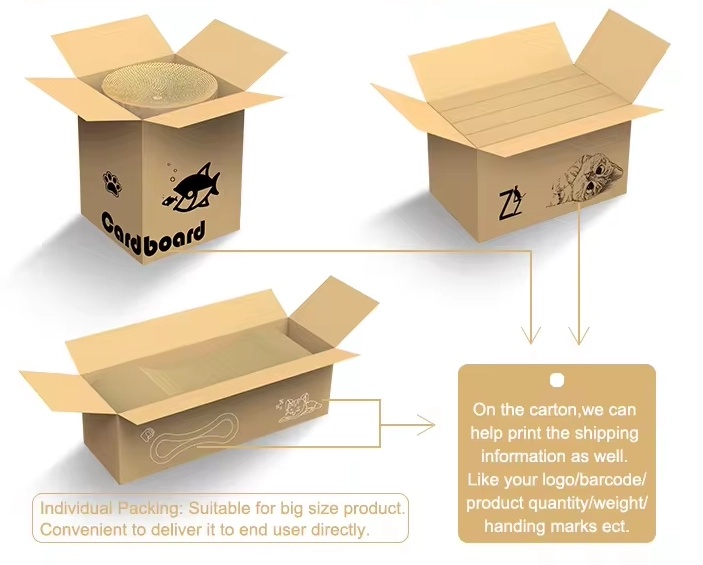
The intended sales channel should determine the packaging design. A scratcher sold in a pet store needs attractive retail packaging and clear product information, while an online-only product needs strong protection against compression, vibration, and handling during parcel delivery. A wholesale program also requires efficient master cartons, stable pallet loads, and clear carton labels.
Buyers should tell the supplier whether the product will be sold through retail stores, online marketplaces, distributors, subscription boxes, or a combination of channels. For marketplace fulfillment, packaging must also meet the platform’s labeling, barcode, carton, and damage-prevention requirements. ISTA’s Amazon over-boxing protocol, for example, evaluates packaged products up to 70 lb (32 kg) and uses defined damage-tolerance criteria for e-commerce fulfillment.
Specify the Retail Package
“Custom packaging” is too vague for production. Buyers should specify whether they need a folding carton, printed sleeve, corrugated mailer, hang tag, display-ready box, or a combination of these components. The RFQ should also state the internal and external dimensions, allowing enough room for the scratcher, catnip packet, instruction card, and protective inserts.
Material choices matter as much as appearance. Specify the paperboard or corrugated board grade, thickness, stiffness, recycled-content requirement, and whether the package needs a window, handle, hang tab, or easy-open feature. Print requirements should include the number of colors, Pantone references, print placement, inside or outside printing, and finishes such as matte lamination, gloss lamination, spot UV, embossing, foil, or soft-touch coating.
| Packaging element | What the buyer should specify |
|---|---|
| Package structure | Folding carton, printed sleeve, corrugated mailer, display box, hang tab, or window |
| Dimensions | Internal and external size, clearance for accessories, and shelf or pallet constraints |
| Material | Paperboard grade, corrugated flute, thickness, stiffness, and recycled content |
| Printing | Number of colors, Pantone codes, artwork placement, inside/outside printing, and print method |
| Finishing | Matte or gloss lamination, spot UV, embossing, foil, soft-touch coating, or uncoated kraft |
| Opening and handling | Easy-open design, resealability, carry handle, hang tab, and assembly instructions |
| Sustainability | Recyclability, recycled-content percentage, plastic-free materials, and certification requirements |
If sustainability is part of the brand positioning, do not rely on general claims. Define whether the packaging must be recyclable, plastic-free, made with a minimum percentage of recycled material, or certified under a recognized standard. The supplier should confirm that the selected materials and printing methods can support the exact claim printed on the package.

Protect the Product in Transit
Cardboard cat scratchers can be damaged by crushing, edge impacts, moisture, and repeated handling. Packaging should therefore include both the retail package and the export or shipping packaging, rather than treating them as separate decisions.
Buyers should require the supplier to propose and confirm the inner protection method, such as bubble wrap, molded pulp, corrugated dividers, foam corners, tissue paper, or a poly bag. For products shipped in humid climates or by sea, moisture protection may be necessary. The master carton should also be specified in detail, including its dimensions, board strength, units per carton, stacking pattern, gross weight, and pallet configuration.
For heavier scratchers, multi-piece designs, or products sold through parcel networks, buyers should ask for drop, compression, and vibration testing. A supplier may be able to produce an attractive retail box, but that does not guarantee that the package will survive warehouse handling and last-mile delivery. Testing the complete packaging system before mass production is the safer approach.
Control Branding and Compliance
Private-label packaging must communicate a consistent brand identity. Buyers should provide final print-ready artwork, including logo files, brand colors, fonts, product photography, and approved claims. The artwork should clearly show where the logo, product name, features, barcode, warnings, and legal information will appear.
The specification should also cover compliance and consumer information. Depending on the destination market, this may include country of origin, manufacturer or importer details, material disclosures, safety warnings, language requirements, recycling symbols, and barcode standards. Buyers should approve a pre-production sample before mass production, because color variation, print registration, material substitution, and missing legal text are common sources of disputes.
Set Quality Standards
A clear quality standard protects both parties. The approved sample should become the reference for material, color, print quality, dimensions, construction, finish, and packing method. Buyers should state acceptable tolerances for package size, color variation, print alignment, glue marks, dents, torn hang tabs, and barcode readability.
The production agreement should also define when inspections occur and what happens if defects are found. Common checkpoints include material inspection, in-line production checks, final random inspection, carton drop testing, and third-party pre-shipment inspection. For larger orders, a third-party inspection is particularly useful for verifying carton labels, packing quantities, packaging condition, and compliance with the approved sample.
Put Everything in the RFQ
A complete RFQ prevents misunderstandings and makes supplier quotations easier to compare. It should combine the product specification, packaging structure, artwork, logistics requirements, compliance needs, quality standard, and commercial terms in one document.
At minimum, buyers should provide the scratcher model and dimensions, target market, sales channel, retail-package design, e-commerce packaging requirements, master-carton details, branding files, barcode requirements, destination country, expected order quantity, target cost, lead time, and Incoterms. The more precise the brief, the less likely the factory is to substitute materials, change the box structure, or produce packaging that cannot survive shipping.
Final Recommendation
Private-label buyers should treat packaging as a controlled component of the cat scratcher, not a final-minute printing job. A detailed specification covering retail presentation, protective packing, export cartons, branding, compliance, testing, and inspection will reduce damage, protect margins, improve shelf appeal, and make the program easier to scale.