Custom-Printed Cat Scratchers: Artwork and Material Review Checklist
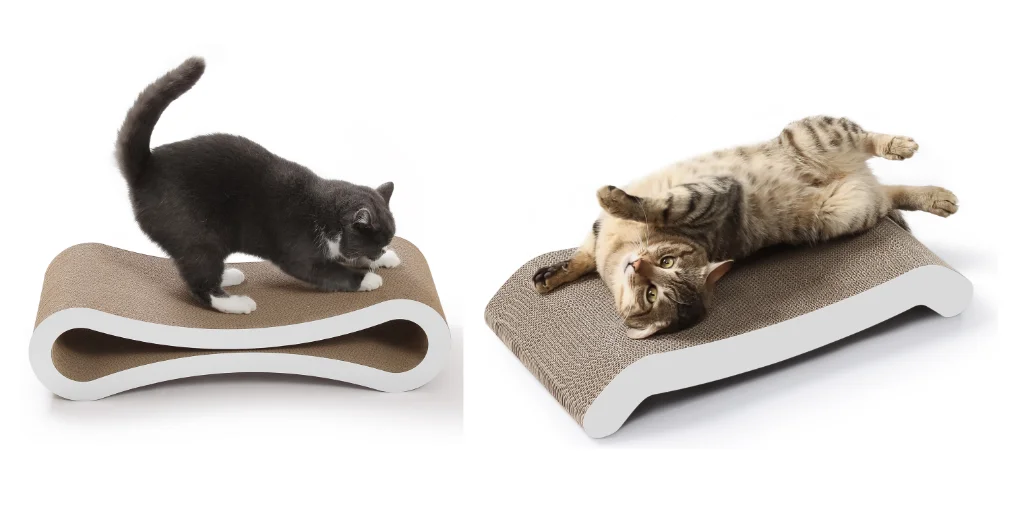
Custom-printed cat scratchers look like an easy product to specify. The unit is a corrugated box, or a board wrapped in sisal, or a small house with a hole in one side. The print is a logo and a pattern. Nothing about the category suggests the tolerance stack of a consumer electronics programme.
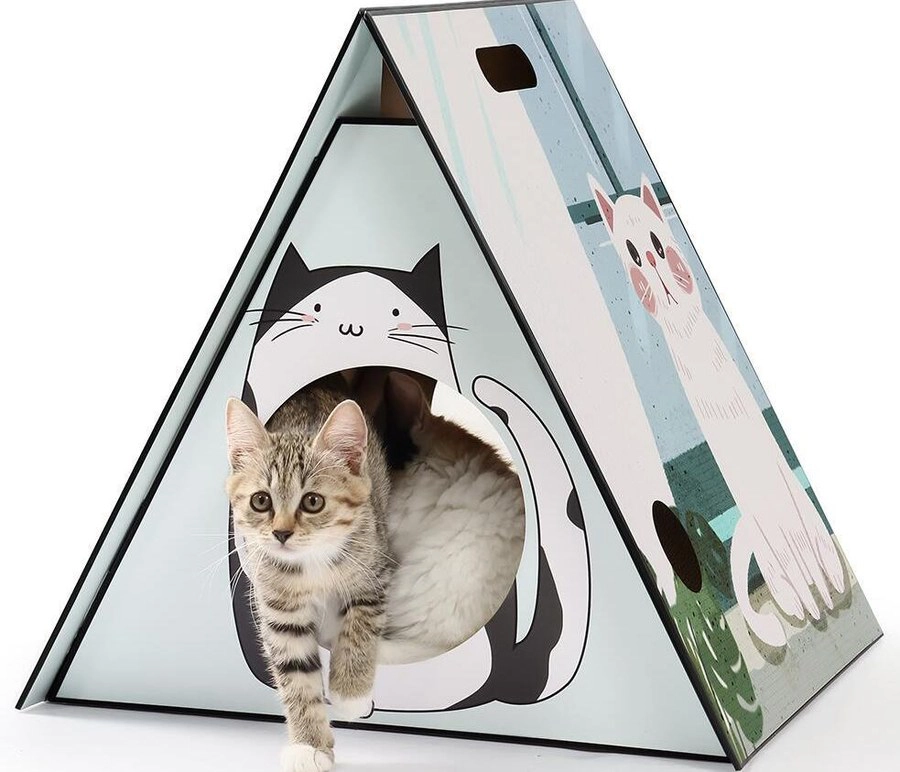
That impression is expensive. A scratcher is simultaneously a printed display object, a piece of light furniture, and a surface an animal will bite, claw and sleep against. Those three roles are governed by different physics. Print quality is decided by ink chemistry and liner absorbency. Structural survival is decided by moisture and edge crush. Safety is decided by what migrates out of the ink and whether any metal sits at whisker height. A programme that reviews only the first of these will pass its proof, pass its inspection, and still generate returns in the second winter after launch.
The review below follows the order in which decisions actually lock, because that is the order in which they become unrecoverable. Once a dieline is approved and plates are cut, artwork problems cost a reprint. Once a container ships at 11% moisture, material problems cost a season.
Where these products actually fail
Three failure modes account for most of the complaints in this category, and none of them are visible on a flat proof.
The first is colour drift on recycled liner. A brand palette approved on white coated stock lands on brown test liner and shifts several units in b*, which is enough for a colour-managed retailer to reject a pallet against a brand guideline. The fix is a white flood coat or an opaque base, decided before plates are made, not discovered at inspection.
The second is compression loss. Corrugated board is a hygroscopic structure, and its stacking strength falls as moisture content rises. A unit that holds 20 kg in a dry warehouse in February can lean in a humid flat in July. Boards are normally specified and shipped between roughly 6% and 9% moisture content; above that, the safety margin you calculated on paper is no longer the margin you have in the field.
The third is the fold. Printed ink is a brittle film on a fibrous substrate. Run a heavy ink laydown across a crease and the film cracks along the score line — often not at the printer, but after a few weeks of handling in a store. Any artwork review that does not include a folded mockup is reviewing two thirds of the document.
Reading the artwork as a die-line document
Designers are trained to compose a rectangle. Scratchers are not rectangles, and the most useful shift in a review is to stop looking at the artwork as an image and start reading it as a technical drawing with a picture on it.
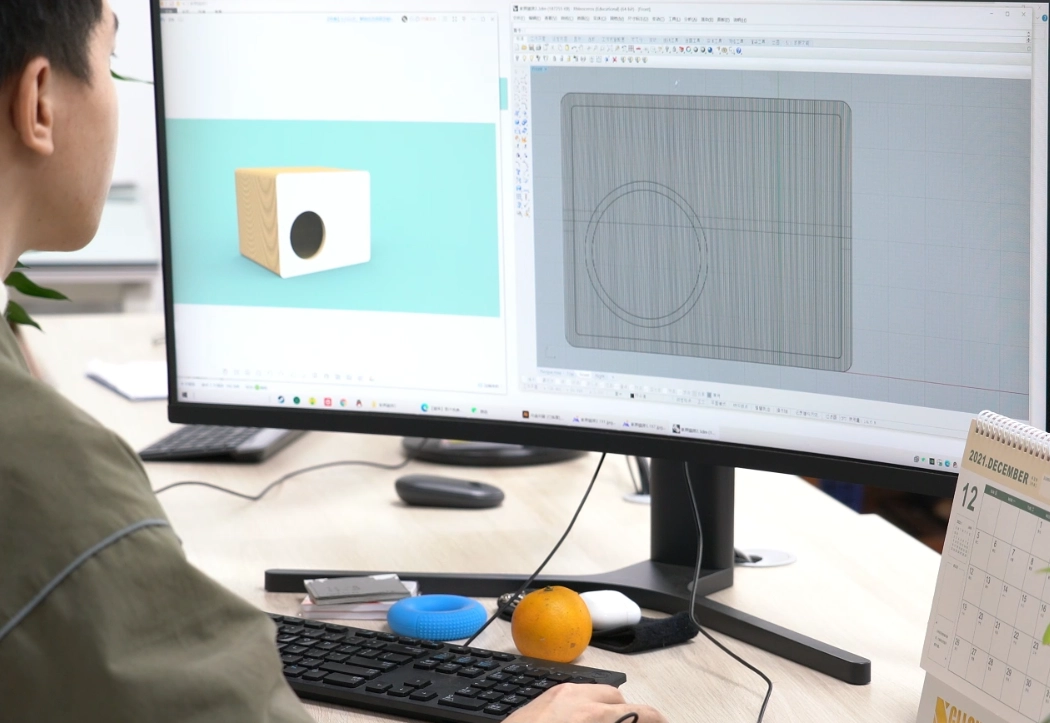
Practically, that means four checks before anything about the design itself is discussed.
The dieline must be the current revision, and its revision identifier should appear on the artwork file itself rather than in an email thread. Version drift between a designer's file and a converter's tool is the most common cause of a reprint in small-format packaging, and it is entirely preventable with one line of text in a corner.
Artwork should sit on its own layer, separate from the dieline. The cut and crease lines should be a named spot colour set to overprint, never flattened into the image and never rebuilt by hand. When a dieline arrives flattened, the converter is guessing, and the guess is usually about which line is a cut and which is a crease.
Safe margins on corrugated want to be wider than designers expect. 3 mm is normal for folding carton; 5 mm is a more realistic floor on board, because the sheet moves during die-cutting. Critical text — brand name, size, warnings — should sit at least 8 mm clear of any crease, for the cracking reason above.
Finally, position the functional elements deliberately. The barcode needs at least 80% magnification and a 3 mm quiet zone, and it should never fall on a flute crest, where the surface is uneven and the scan unreliable. A printed barcode should be verified with a scanner on the printed sheet; a PDF that scans on a monitor proves nothing about the board.
There is also a question of audience that gets skipped. The artwork faces the owner, not the cat. Cats are dichromats, and reds and greens read as similar values to them while blues and yellows separate clearly — which matters if a feature is being signalled by colour alone. Signal it with shape or position instead, and let colour do its work on the human standing in the aisle.
Colour on brown board is a chemistry problem
The most useful conversation to have with a converter is about the liner, not the ink.
Recycled test liner is darker, more absorbent and more variable than virgin kraft, and it varies batch to batch. Ink printed directly onto it does not simply look darker; it changes hue, because the substrate is reflecting a different spectrum back through a translucent film. Yellows go olive. Light blues go grey. Metallics disappear.

The professional response is to specify an opaque white base under any colour that must match a brand standard, and to approve that base on production board rather than on white stock. Where an uncoated, natural look is the design intent, the honest approach is to treat the colour as approximate and to say so in the brand guideline, rather than to chase a match the substrate will not permit.
Two other numbers belong in the print specification. Total ink coverage on liner is usually capped in the region of 240–260%, above which the board absorbs ink faster than it can dry evenly and the surface scuffs in transit. And large solid dark areas will show flute lines — washboarding — on any corrugated substrate. This is physics, not printer incompetence. Break up the solid, choose a texture deliberately, or move that panel to a laminated or flat substrate.
Reverse type deserves a specific rule: avoid white text knocked out of a dark solid below about 8 pt on uncoated liner, because ink spread closes the counters. It is legible on screen and illegible on the box.
The material numbers that predict survival
Most material failures trace back to a specification that said "standard board." The parameters below are the ones worth writing into a purchase specification explicitly, with the values that matter in this category.
|
Parameter |
Typical specification |
What it controls |
|---|---|---|
|
Flute |
E-flute for print-led small units; B-flute for structure; BC double wall for large houses |
Print surface smoothness versus crush resistance |
|
Liner |
150–200 gsm test liner, virgin or recycled stated |
Colour behaviour and absorbency |
|
Board grade |
A stated ECT value, e.g. ECT-32, tested to ISO 3037 or TAPPI T-811 |
Stacking and compression performance |
|
Moisture content |
6–9 per cent at shipment |
Everything about strength after week one |
|
Sisal |
Density and wrap tension specified; undyed by default |
Scratch life and fibre shedding |
Two of these deserve emphasis. Edge crush test predicts stacking strength far better than basis weight, and it is the number a converter can actually certify. Moisture content is the number almost nobody records, and the one that most often explains a field failure that looks inexplicable in the lab.
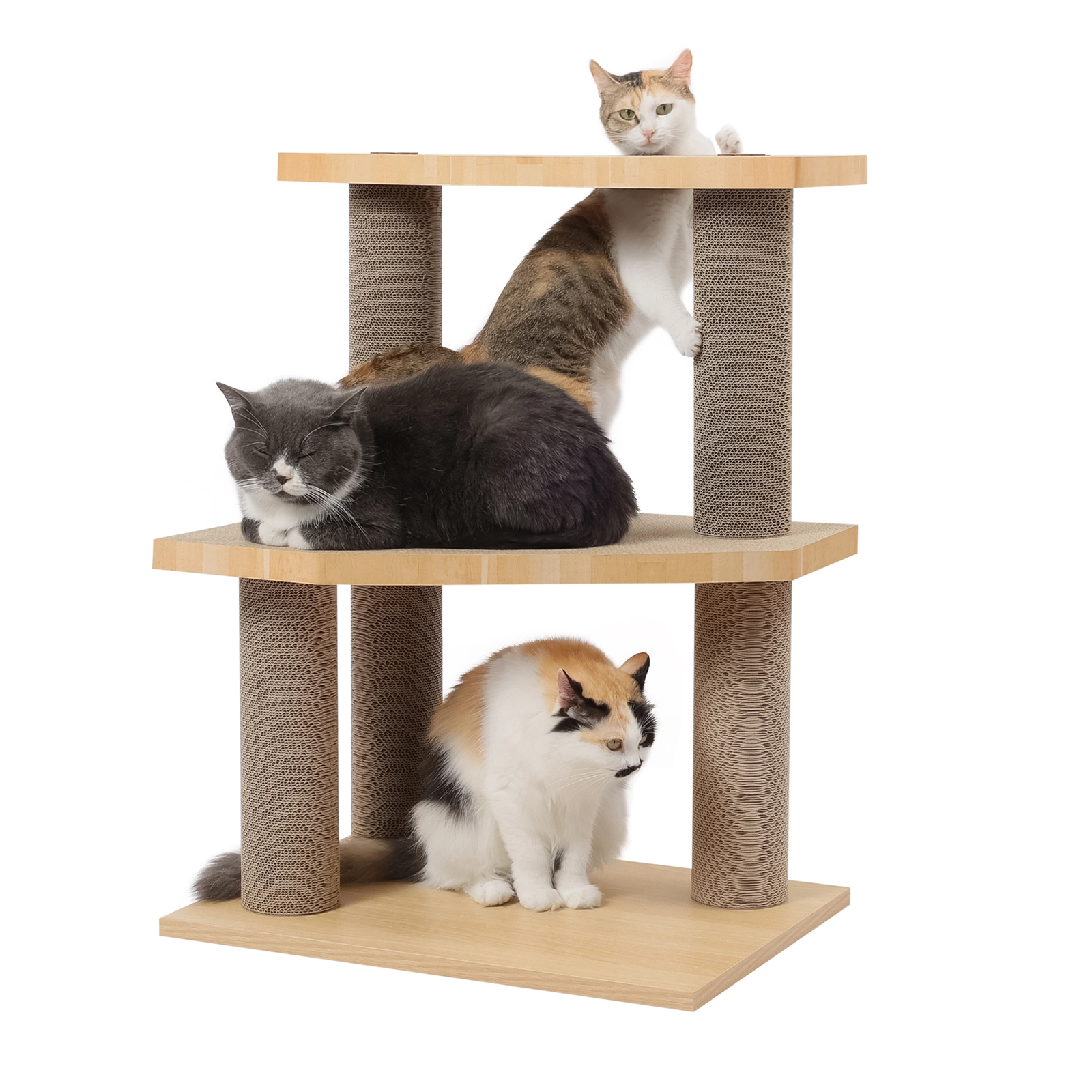
Sisal is usually left vague, which is a mistake. Loose wraps shed fibre and fail early; over-tight wraps compress the adhesive layer and the wrap detaches as a sleeve. If the sisal is dyed, ask for a heavy-metal and azo-dye statement rather than a colour name. Where the product is a cardboard scratch pad rather than a wrapped post, specify that the exposed medium is the fluted layer and design for replacement or full recyclability, because a pad glued permanently into a laminated house is a disposal problem the customer will notice.
Adhesives should be starch-based or hot melt. Solvent-based adhesives in an enclosed cardboard house produce an odour that reads to a cat owner as chemical, and cats are more sensitive to volatiles than the quality form assumes. Adhesive should also never run across a crease, for the same cracking reason that governs ink.
Hardware is where safety and cosmetics overlap. Any staple, screw or clip should be recessed or covered. Exposed metal at cat height is not a cosmetic defect; it is the defect.
Matching the print process to the run
Flexography with water-based inks remains the default above roughly a thousand units, because the plates cost money once and the per-unit cost is low. Its limit is detail: fine halftones and small reversed type will not hold on liner. Digital UV flatbed printing has made short runs and variant testing genuinely viable, and it is the right answer for test markets and limited editions, provided ink adhesion at creases is verified — UV ink films are less flexible than water-based films and crack at scores that would survive flexo.

Litho-lamination delivers the best graphics in the category and is worth its cost on gift sets and premium retail programmes, with one caveat: the laminated sheet can delaminate under sustained humidity, so the humidity test matters more here, not less. Screen printing works for bold single-colour branding on assembled units but is slow at volume and drifts in registration on textured board. Laser engraving on wood or MDF components sidesteps ink entirely and produces a permanent mark, at the cost of a scorch smell that needs extraction and a burn consistency check across the run.
Whichever route is chosen, the ink specification should say water-based and heavy-metal-free, with a statement against EN 71-3 migration limits and the current REACH SVHC list. It is worth being precise about what that buys you. Cat scratchers are not children's toys and are not regulated as such. But retailers increasingly apply toy-adjacent due diligence, and the paperwork is far cheaper than a delisting.
What the standards do and do not cover
This is the part of the guide where a reader deserves honesty about the limits of the evidence.
There is no product safety standard written specifically for cat scratchers. What exists is a set of adjacent instruments that a responsible programme borrows from. EN 71-3 governs migration of certain elements from toy materials and is the usual reference for ink safety. REACH Annex XVII and the SVHC candidate list govern restricted substances and disclosure in the European Union. California Proposition 65 governs warning obligations in the United States. ISO 3037 and TAPPI T-811 give repeatable edge crush numbers, ASTM D642 covers compressive strength of shipping containers, and ISTA 3A is the sensible protocol for parcel-shipped units. Rub resistance has a standard test of its own, ASTM D5264, typically run to 50 cycles or more on the printed surface.
None of these certify the product. They give you reproducible measurements and defensible paperwork, which is a different and more useful thing. A supplier who describes a scratcher as EN 71 certified is presenting a test report as a certificate, and that distinction is worth pressing on.
How this guide was put together, and where it stops
The thresholds above are drawn from published test methods and from tolerances commonly quoted by corrugated converters and packaging engineers. The ranges are typical rather than universal, and they vary with board grade, converter capability and climate. Where a range appears — 5 mm of safe margin, 240–260% ink coverage, 6–9% moisture, 50 rub cycles — treat it as a starting point for your own specification rather than as a compliance limit.
Two practical notes for anyone using this as a review instrument. The checks that catch the most problems are the cheapest: a folded mockup, a drawdown on production board, and a moisture reading at shipment. None of them require laboratory time. And the review is only as good as its stopping power. Someone has to be able to hold a shipment, and that authority should be written down before the first purchase order rather than negotiated after the first rejection.